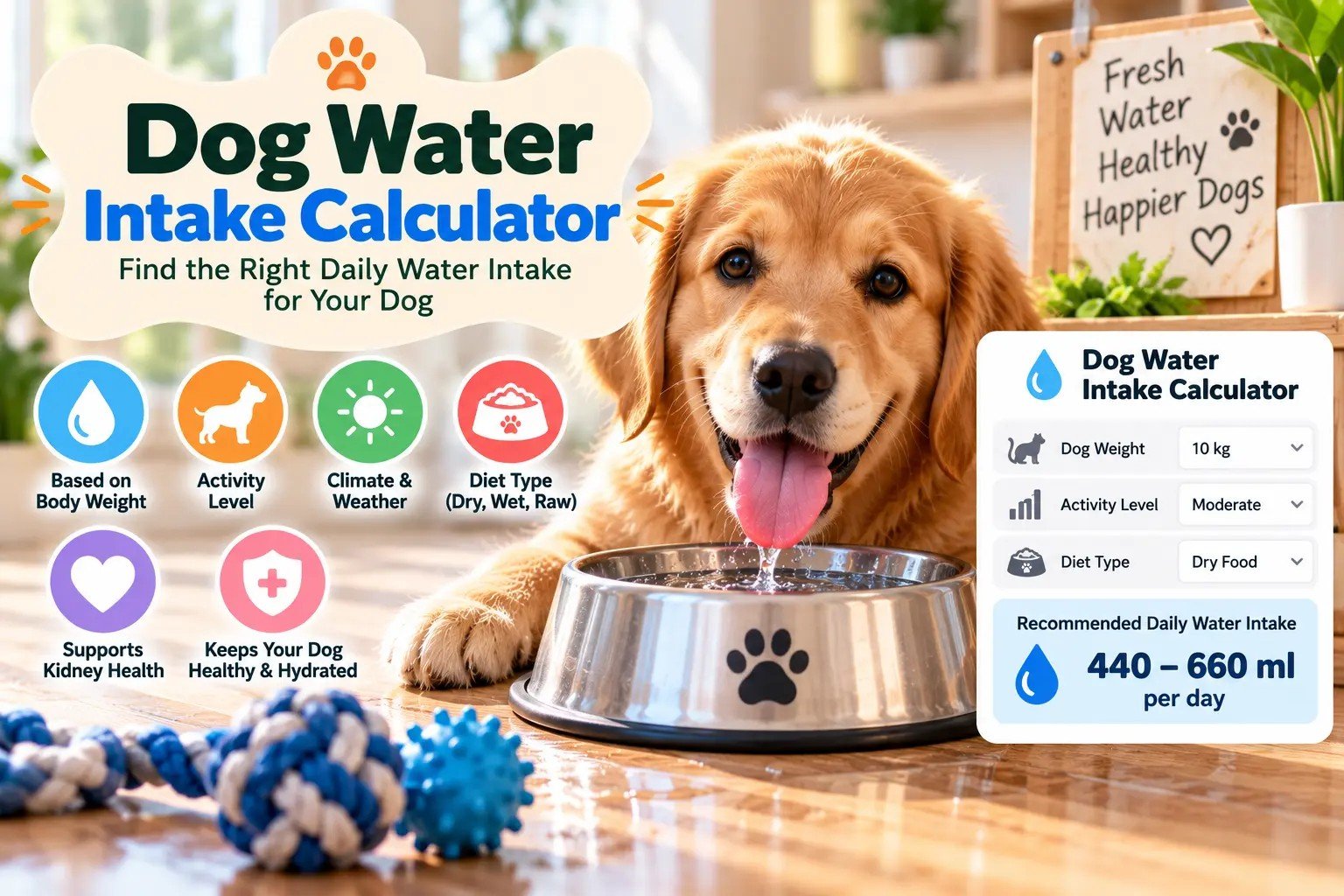
Dog Water Intake Calculator
Enter your dog’s body weight to get a science-based reference range for daily water intake.
This is an estimate, not a prescription. Actual intake varies with diet, environment, health status, and individual differences. Dogs on wet/canned food typically drink less because food moisture contributes to total water intake. Always ensure your dog has free access to fresh, clean water. If you notice a significant and unexplained change in your dog’s drinking habits, consult your veterinarian.
Formula basis: Merck Veterinary Manual – Nutritional Requirements of Small Animals (updated Sept 2024). General mammalian reference: approximately 44–66 mL/kg/day under thermoneutral conditions (Merck Veterinary Manual). This is not a dog-specific prescription.
How Much Water Does a Dog Need Per Day?
Merck Veterinary Manual describes approximately 44–66 mL/kg/day as a general water-intake estimate for most mammals under thermoneutral conditions. Individual dogs may have different water needs, and this range should not be treated as a dog-specific prescription.
A 22 lb (10 kg) dog, for example, falls in the range of roughly 440–660 mL (about 1.9–2.8 cups) per day. A 44 lb (20 kg) dog falls in the range of roughly 880–1,320 mL (about 3.7–5.6 cups) per day.
These figures reflect total water needs — which can come from drinking water, food moisture, and metabolic processes. The calculator above estimates water based on body weight alone and should be used as a reference point, not a target to measure or enforce. For a weight chart and more detail, read our guide on how much water a dog needs per day.
Food Moisture and Total Water Intake
Not all of a dog’s water comes from the bowl. According to the Merck Veterinary Manual, wet (canned) dog foods contain approximately 60–87% moisture, while dry kibble contains only about 3–11%. Semi-moist foods fall somewhere in between at around 25–35%.
Dogs eating primarily wet food typically drink noticeably less water than dogs on a dry-food diet — this is completely normal. The Merck Veterinary Manual notes that healthy animals can effectively self-regulate their water intake, and that water intake should not be restricted in general.
Should You Measure Your Dog’s Water Intake?
For most healthy dogs, the answer is no. Healthy dogs drink what they need. The reference range from this calculator is most useful as a general awareness tool, not as a daily tracking target.
That said, it can be helpful to have a sense of your dog’s typical drinking patterns. If you notice that your dog is drinking significantly more or less water than usual — without an obvious cause such as hot weather, exercise, or a diet change — it is worth discussing with your veterinarian, as changes in thirst can sometimes indicate underlying health issues.
Signs Your Dog May Need Veterinary Attention
The calculator cannot assess your dog’s health. If your dog shows any of the following signs, contact your veterinarian rather than relying on this tool:
- A sudden, significant increase in water consumption or urination
- A sudden, significant decrease in water consumption
- Lethargy, vomiting, or loss of appetite alongside changes in thirst
- Skin that does not spring back quickly when gently pinched (a basic at-home hydration check — your vet can demonstrate this)
- Dry, sticky gums
These signs may or may not indicate a health problem, and only a veterinarian can make that determination through a proper examination.
Tips for Keeping Your Dog Hydrated
- Fresh water, always available. Keep the bowl clean and topped up throughout the day.
- Multiple bowls. In a large home, having water in more than one location encourages drinking.
- After exercise. Offer water after walks or play sessions — your dog will drink what they need.
- Water fountains. Some dogs prefer moving water; a pet fountain may encourage them to drink more.
- Travel. Always carry water on car trips or hikes.
Frequently Asked Questions
How much water should a dog drink per day?
The Merck Veterinary Manual describes approximately 44–66 mL/kg/day as a general estimate for most mammals under thermoneutral conditions. Individual dogs may have different water needs, and this range should not be treated as a dog-specific prescription. Actual intake depends on diet (wet food contributes significant moisture), activity level, temperature, and the individual dog. Healthy dogs self-regulate their intake; always make fresh water freely available.
Is it normal for my dog to drink less water when eating wet food?
Yes, this is entirely normal. Wet (canned) dog food contains approximately 60–87% moisture, according to the Merck Veterinary Manual, compared to only 3–11% for dry kibble. Dogs on wet food diets get a significant portion of their total water intake from food and therefore drink less from the bowl. As long as your dog has free access to water and is otherwise healthy, lower bowl intake on a wet diet is not a cause for concern.
Should I limit my dog’s water intake to the calculator’s estimate?
No. You should never restrict your dog’s access to fresh water based on a calculator estimate. The Merck Veterinary Manual states that water intake should not be restricted in healthy animals. This calculator provides a reference range for awareness purposes only. If you are concerned about how much your dog is drinking, speak with your veterinarian — do not reduce water access on your own.
My dog is drinking a lot more water than the calculator shows. What does that mean?
This calculator cannot diagnose any health condition. A noticeable, unexplained increase in water consumption in dogs can be associated with a variety of causes — some temporary (such as hot weather, increased activity, or a recent diet change) and some that warrant veterinary evaluation. If you are concerned about your dog’s water intake, the appropriate step is to contact your veterinarian for a proper assessment.
How is the dog water intake reference range calculated?
The calculator uses the reference range of approximately 44–66 mL per kilogram of body weight per day, sourced from the Merck Veterinary Manual’s section on Nutritional Requirements of Small Animals (updated September 2024). This reference describes general water-intake estimates for most mammals under thermoneutral conditions. It should not be interpreted as a dog-specific requirement. No adjustment multipliers for activity, weather, breed, age, or diet type are applied, as there is insufficient published veterinary data to support specific quantitative adjustments for those factors.
How do I convert the mL result to cups or ounces?
The calculator automatically shows the result in mL, fluid ounces, and cups. For manual conversion: 1 mL equals approximately 0.0338 fl oz, and 1 cup equals approximately 237 mL. For example, 500 mL is roughly 16.9 fl oz or about 2.1 cups.