Cat Food Calculator
Work out how much of your cat’s actual food to feed each day. The calculator first estimates your cat’s daily energy needs from weight, life stage and a cat-specific energy factor, then uses the calorie density printed on your food’s label to turn those calories into a portion. It works for dry food (cups or grams) and wet food (cans, pouches, trays or grams), with a per-meal split and an optional treat allowance. It’s an educational estimate, not a veterinary feeding prescription.
Your cat’s feeding estimate
You’ve changed some inputs. Press Calculate My Cat’s Food to update these results.
Fill in steps 1–3 and press Calculate My Cat’s Food. You’ll see:
- How much of your food to feed per day
- The amount per meal
- Estimated daily calories and any treat allowance
- Every number used in the calculation
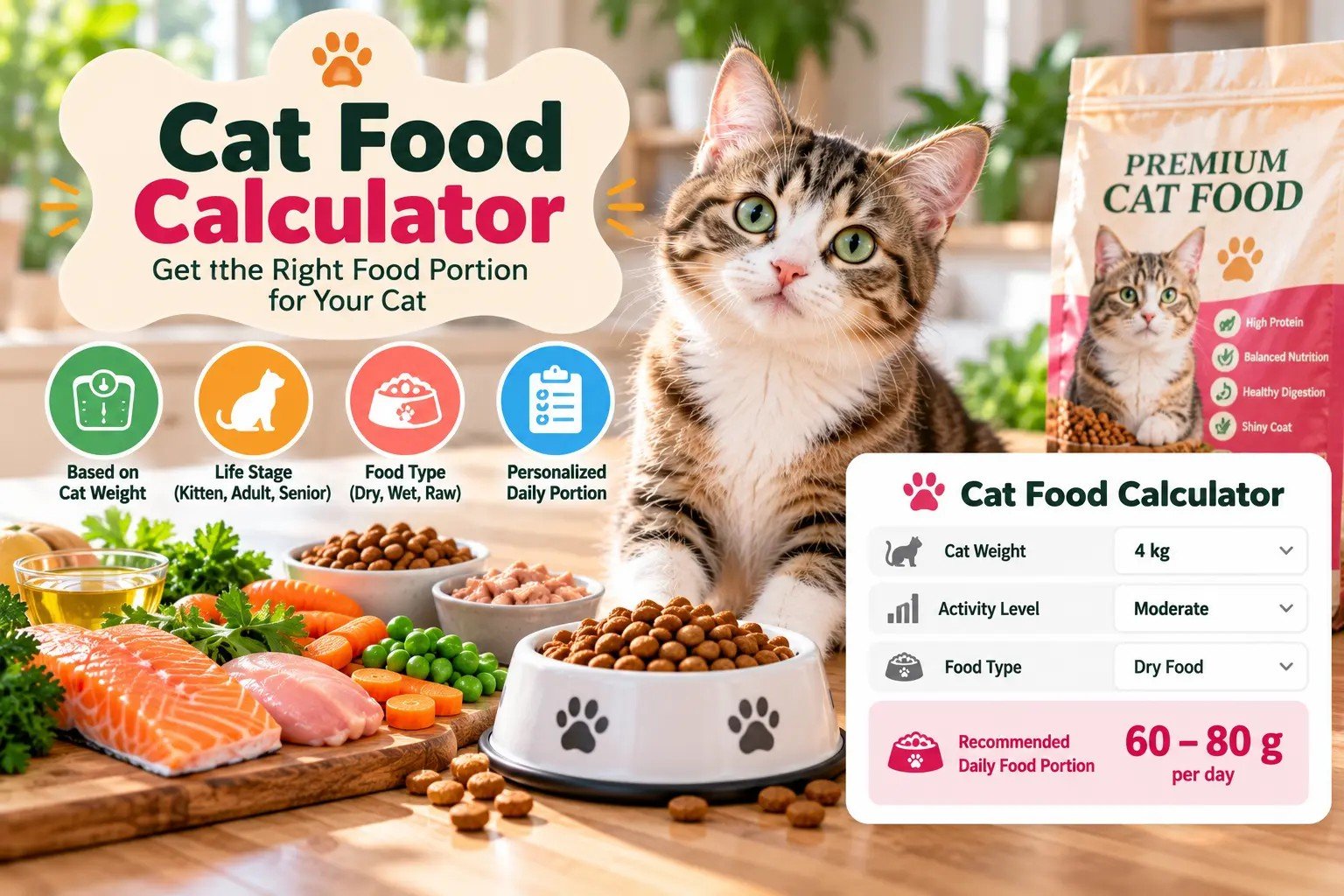
How to Use the Cat Food Calculator
- Enter your cat’s current weight in kg or lb.
- Choose kitten, adult or senior, then the description that best fits an adult or senior cat.
- Enter the calorie density from your food’s label and pick the matching unit.
- Choose how many meals a day you’d like to split the food into.
- If your cat gets treats, choose a treat allowance.
- Press Calculate My Cat’s Food.
- Feed the estimate, monitor weight and body condition, and adjust with veterinary guidance where needed.
How the Cat Food Calculator Works
- Weightlb converted to kg
- RERresting energy
- Feline factorone cat-specific value
- Daily caloriesRER × factor
- Treat allowancetaken out, not added
- Food calorieswhat’s left for the main food
- Food portion÷ your label’s calories
- Per mealportion ÷ meals
Cat Food Calculator Formula & Methodology
1. Resting Energy Requirement (RER)
Pounds are converted to kilograms first (1 kg = 2.2046226218 lb). The same RER equation is used for cats and dogs.
RER = 70 × (body weight in kg)0.75
2. Estimated daily calories
Estimated daily calories = RER × ONE feline energy factor
The calculator selects exactly one factor from the table below. Factors are never multiplied together, so neuter status and activity can’t be double-counted.
3. Treat allowance
Treat calories = daily calories × treat % · Main food calories = daily calories − treat calories
4. Daily food portion
| Your label shows | Calculation | Extra result if you add |
|---|---|---|
| kcal per cup | Cups/day = main food calories ÷ kcal per cup | Grams per cup → grams/day = cups × grams per cup |
| kcal per 100 g | Grams/day = main food calories ÷ kcal per 100 g × 100 | Grams per cup → cups/day = grams ÷ grams per cup |
| kcal per kg | Grams/day = main food calories ÷ kcal per kg × 1,000 | Grams per cup → cups/day = grams ÷ grams per cup |
| kcal per can | Cans/day = main food calories ÷ kcal per can | Can net weight → grams/day = cans × can weight |
| kcal per pouch/tray | Pouches/day = main food calories ÷ kcal per pouch | Pouch net weight → grams/day = pouches × pouch weight |
5. Per meal
Amount per meal = daily portion ÷ meals per day
Full precision is kept throughout and only rounded for display: calories to the nearest kcal, cups, cans and pouches to 2 decimals, and grams to the nearest gram (one decimal below 10 g).
Feline Energy Factors Used by This Calculator
These are the only factors the calculator uses. They are cat-specific published starting points, not exact requirements, and none are taken from dog tables.
| Cat profile | Factor | When used | Source basis | Important limitation |
|---|---|---|---|---|
| Growing kitten | 2.5 × RER | Life stage: Kitten | Merck: healthy kittens 2.5 × RER. Pet Nutrition Alliance: growth 2–3 × RER. | One factor for all weaned kittens; the published range is 2–3 and needs start falling from around 4 months. Recalculate often. |
| Neutered/spayed adult | 1.2 × RER | Adult or Senior + “Neutered or spayed” | Merck 1.2; Pet Nutrition Alliance 1.2 | A population average for healthy adults; individual cats vary. |
| Intact adult | 1.4 × RER | Adult or Senior + “Intact” | Merck 1.4; Pet Nutrition Alliance 1.4 | A population average for healthy adults; individual cats vary. |
| Adult, obesity-prone or inactive | 1.0 × RER | Adult or Senior + “Obesity-prone or inactive” | Merck: “obesity prone” 1 × RER. Pet Nutrition Alliance: “overweight-prone/inactive” 1.0 × RER. | A starting estimate for maintenance, not a weight-loss prescription. Weight-loss plans are set separately with a vet. |
| Senior cats | No separate factor | Senior uses the adult row you choose | No senior-cat factor is published in these sources. | Seniors vary widely in activity, muscle, body condition and health. |
Not covered: pregnancy, nursing, weight-loss programmes, medical conditions and therapeutic diets. For weight loss, use the cat weight loss calculator. Sources are listed at the end of this page.
Worked Example: Feeding a 4 kg Neutered Adult Cat
One made-up cat and food, to show the steps. The food’s calorie density is an example only; it doesn’t represent all wet or dry foods.
- Cat: 4 kg, adult, neutered
- RER: 70 × 40.75 = 70 × 2.828 ≈ 198 kcal/day
- Factor: neutered adult = 1.2
- Estimated daily calories: 198.0 × 1.2 ≈ 238 kcal/day
- Treats (10% option): ≈ 24 kcal/day, leaving ≈ 214 kcal/day for the main food
- Example food: a wet food labelled 85 kcal per 100 g
- Daily portion: 213.8 ÷ 85 × 100 ≈ 252 g/day
- Meal split: 2 meals → ≈ 126 g per meal
With no treats, the same cat would get all 238 kcal from the food: 237.6 ÷ 85 × 100 ≈ 280 g/day.
Entering Your Food’s Label: Cups, Grams, Cans and Pouches
Dry food: enter the kcal per cup from the label. A cup measures volume, not weight, and there’s no universal cup-to-gram conversion, so the calculator never assumes one. If you know how many grams one level cup of your food weighs, add it to see grams as well.
Wet food: enter the calories per can, pouch or tray printed on your label, and add the net weight if you’d also like grams. Container sizes and calories vary, so one can is not equivalent to another.
Mixing wet and dry: decide how many calories come from each food and calculate each portion with its own label value, or use the Wet + Dry Feeding Calculator.
Using Your Result
The result is a starting estimate, not a fixed amount. If you choose a 5% or 10% treat allowance, those calories are taken out of the daily total and the food portion is reduced to match; treat calories are never added on top. The Merck Veterinary Manual advises keeping treats below 10% of daily calories.
Kittens use a growth factor (2.5 × RER); for growth-based portions use the Kitten Feeding Calculator. Senior cats have no separate factor here: choose the adult profile that fits your cat now.
Weigh your cat every 2–4 weeks at first, watch body condition, and recalculate when you change food or your cat’s weight, life stage or neuter status changes. Adjust in small steps rather than making large, sudden cuts.
Want to understand why feeding amounts vary, how often to feed and how to adjust portions over time? Read our complete cat feeding guide.
Related Cat Nutrition Tools
More cat tools are being built. Each card will become a link when its page is published. Meanwhile, visit the Cat Nutrition hub.
Cat Nutrition Hub
All cat calculators and feeding information.
Cat Calorie Calculator
Daily calorie needs on their own.
Cat RER Calculator
Resting Energy Requirement from body weight.
Kitten Feeding Calculator
Feeding estimates for growing kittens.
Cat Treat Calculator
A daily treat-calorie allowance.
Cat Water Intake Calculator
Typical daily water needs.
Cat Weight Loss Calculator
An educational, vet-guided starting calorie target.
Cat Protein Calculator
Protein on a dry-matter and per-calorie basis.
Cat Food Calculator FAQ
How does a cat food calculator work?
It calculates the Resting Energy Requirement (70 × body weight in kg to the power 0.75), multiplies it by one cat-specific factor, removes any treat allowance, and divides the remaining calories by your food’s label value to get a daily portion.
How do I calculate grams of cat food per day?
Divide the calories for the main food by the kcal per 100 g on the label, then multiply by 100. For example, 214 kcal ÷ 85 kcal per 100 g × 100 ≈ 252 g per day.
How many cans of wet food should I feed my cat?
Divide your cat’s main food calories by the kcal per can on the label. Cans vary in size and calories, so there is no standard number of cans per day.
Is a cup of cat food the same number of grams for every food?
No. Dry foods have different densities, so one cup can weigh different amounts. Weigh a level cup of your own food, or use the label figure, to convert between cups and grams.
Do treats count toward daily calories?
Yes. The Merck Veterinary Manual advises keeping total daily treats below 10% of total calorie intake. The calculator subtracts your chosen treat allowance before working out the food portion.
What do I enter if my food’s label only lists kcal/kg?
Choose the per-kilogram unit and enter the kcal/kg value from the label. The calculator converts it to grams per day. Add grams per cup if you also want the amount in cups.
Sources
- Merck Veterinary Manual: Daily Maintenance Energy Requirements for Dogs and Cats: healthy adult cats intact 1.4, neutered 1.2, obesity prone 1 (× RER); healthy kittens 2.5 × RER.
- Pet Nutrition Alliance: Calculating Calories Based on Pet Needs: RER equation (same for cats and dogs); cats neutered 1.2, intact 1.4, overweight-prone/inactive 1.0, growth 2–3.
- Merck Veterinary Manual: Feeding Practices in Small Animals: treats less than 10% of total calorie intake.
- Merck Veterinary Manual: Nutritional Requirements of Small Animals: water intake and canned food.
- Merck Veterinary Manual (Cat Owners): Disorders of the Liver and Gallbladder in Cats: hepatic lipidosis.
PawCalcHub provides educational estimates only. Results are not veterinary advice, diagnosis or a prescription. This page has not been reviewed by a veterinarian.